Artificial intelligence (AI) has evolved from exploratory pilots to enterprise‑wide initiatives. Across sectors as varied as finance, healthcare, education and logistics, leaders are placing significant bets on AI to enhance competitiveness. As budgets rise, stakeholders naturally ask: how should we evaluate whether an AI project or solution is truly worth pursuing? This issue was highlighted in a recent MIT report, which found that despite $30–40 billion in enterprise investment in generative AI, 95% of organizations have seen no return and failed to deliver real value (MIT, 2025)
Goal setting can be challenging when an organization is just beginning to adopt and implement an AI solution. Local successes, such as automating a reporting process or deploying a chatbot, often obscure the broader strategic picture. At the opposite extreme, ambitious “moonshot” projects may collapse under the weight of technical or organizational barriers.
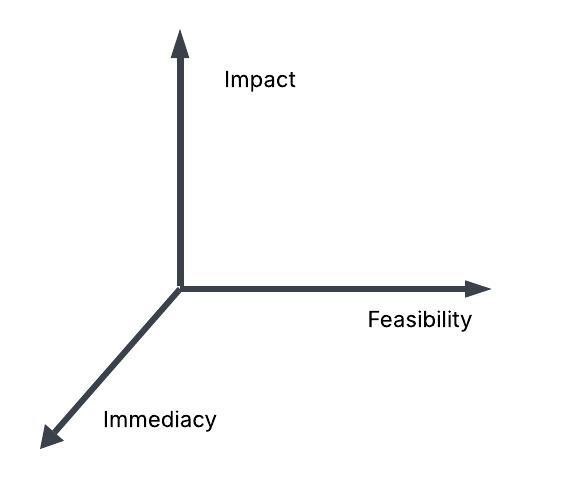
To cut through the noise, it helps to envision each AI initiative as a point in three-dimensional space. Imagine plotting projects along three axes: Impact, Feasibility, and Immediacy—using a Cartesian coordinate system:
- Impact measures the difference a project or solution makes for customers, employees, or users compared with the baseline metric.
- Feasibility gauges whether the organization has the data, skills, and infrastructure to deliver the planned product or solution.
- Immediacy asks how quickly a window of opportunity is closing.
Impact: Does It Truly Matter?
The first dimension, impact, compels leaders to ask how much a proposed AI initiative will actually move the needle. Impact can manifest in several ways.
For revenue growth, a consumer-goods company might use AI to forecast regional demand and adjust pricing dynamically, boosting top-line growth rather than simply reducing costs. A music-streaming platform that leverages generative models to recommend new artists could unlock entirely new revenue streams. On the other hand, cost reduction can also be a key focus. Logistics firms deploy route-optimization algorithms that shave only a few percentage points off each trip but, when multiplied across thousands of journeys, save millions of dollars. Utilities use AI-driven anomaly detection to prevent costly system failures, preserving both financial stability and public trust.
AI can also make positive impact on productivity and innovation. Legal teams can review thousands of contracts in hours rather than months, freeing professionals to focus on negotiation strategy. In pharmaceuticals, AI can accelerate the discovery of promising molecules, allowing scientists to devote more time to creative experimentation. Experience and trust matter too. Travel companies apply AI-based personalization to anticipate guest needs, strengthening loyalty, while financial institutions use AI to explain loan decisions transparently, improving customer confidence.
Not all impact is equal. For business leaders and AI practitioners, it is essential to scope opportunities and quantify expected benefits before developing an MVP—and especially before scaling a solution. They should also define clear metrics—such as revenue gains, cost savings, productivity increases, or customer retention—so they can credibly demonstrate value.
Finally, when evaluating impact, leaders should distinguish between incremental improvements and system-wide transformations to avoid the fallacy of chasing a single “silver bullet.”
Feasibility: Can We Realistically Deliver?
The second dimension grounds ambition in reality. Even high-impact ideas will fail if an organization lacks the resources, data, or expertise to execute them effectively.
Technical feasibility spans several factors. The first is data readiness. For example, a hospital may aspire to build predictive models for patient outcomes, but if medical records are incomplete or siloed across departments, the project will stall. Similarly, a manufacturer might want to implement predictive maintenance, yet without sensors capturing machine performance, the initiative remains aspirational.
Integration complexity presents another hurdle. Banks deploying fraud-detection algorithms must integrate them seamlessly into transaction systems; any latency can cause failed payments and erode customer trust. On the other hand, talent and culture also matter. AI projects require not only data scientists but also product managers, engineers, ethicists, and domain experts working in concert. If employees lack cross-functional literacy or resist adopting AI tools, even the best models will sit unused.
More importantly, governance and risk are often overlooked amid the excitement of innovation. In regulated sectors such as insurance, a black-box model that predicts premiums without transparent reasoning may trigger regulatory backlash and create more problems than benefits.
Feasibility assessments should be continuous rather than one-time checks. As more data becomes available, as infrastructure evolves, or as skills mature, the likelihood of success changes. Organizations should therefore invest not only in pilots but also in closing gaps in data quality, infrastructure, talent, and culture. Pairing domain experts with data scientists ensures that technical solutions remain grounded in real-world needs.
Immediacy: When Should We Act?
The third dimension, immediacy, encourages business leaders to consider that timing shapes value as much as technology. Some projects represent now-or-never opportunities. For example, a healthcare provider may need AI-driven compliance tools before new regulations take effect. Delay in establishing such compliance could result in fines and harm on reputation.
Other initiatives offer strategic quick wins. Chatbots for IT support can reduce ticket volumes within weeks, demonstrating AI’s value while simultaneously building organizational literacy and confidence. Solutions in aerospace or AI-driven drug discovery requires years of research and iteration by focusing on long-term bets. But has the potential to redefine entire industries. Autonomous vehicles likewise demand sustained investment, regulatory approval, and public acceptance.
The key to immediacy lies in balancing urgency and preparedness. Moving too slowly cedes advantage to competitors, while moving too quickly without the right foundations invites failure. Leaders should therefore categorize initiatives by timing, sequence quick wins and long-term bets strategically, and revisit these assessments as market conditions, regulations, and technologies evolve.
Mapping Projects: A Three-Dimensional View
When impact, feasibility, and immediacy are evaluated together, they form a three-dimensional map that clarifies priorities. Projects scoring high on all three dimensions occupy the sweet spot—they deliver measurable value, are technically ready, and align with urgent opportunities. High-impact but less feasible initiatives represent transformative bets, requiring capability building or cultural change before scaling. Those with high feasibility and immediacy but modest impact serve as quick wins that build momentum and stakeholder confidence. Projects scoring low across all axes may be reserved for experimentation or deprioritized.
This framework shifts the question from “Should we do AI?” to “Which AI projects will deliver the most value—and when?” It also fosters alignment across teams.
Leading with Clarity in the Age of AI
AI transformation isn’t a race to adopt every new model or tool, it is a strategic journey that demands thoughtful change management and alignment across the dimensions of impact, feasibility, and immediacy.
Impact ensures initiatives address meaningful problems and create tangible outcomes. Feasibility grounds visionary ideas in data, infrastructure, talent, and governance. Immediacy reminds us that timing is strategic—some opportunities demand swift action, while others require patience and foundation-building.
Leaders who evaluate projects within this three-dimensional space build balanced portfolios that combine quick wins with bold bets. They avoid chasing hype and instead craft resilient, credible AI strategies. In doing so, they will be able to unlock AI’s true promise and lead their organizations with clarity in the age of AI.
References
MIT NANDA, Challapally, A., Pease, C., Raskar, R., & Chari, P. (2025, July). State of AI in Business 2025: The GenAI Divide [Report]. MLQ / Project NANDA. https://mlq.ai/media/quarterly_decks/v0.1_State_of_AI_in_Business_2025_Report.pdf
 Elevation Intelligence
Leave a comment